HOW TO KILL A LYREBIRD

thinkerlarge

By ellymelly – If you enjoy my work, consider shouting me a coffee over on Ko-Fi


Cartoonists matter.

When gunshots echoed down the streets of Paris and images of a blood soaked office hit the press – the world was shocked. Charlie Hebdo, a satirical newspaper, had become ground zero for the violent core of cancel culture. Twelve people were killed including five cartoonists because they dared to poke fun at intolerant Islamic extremism. In particular, the cartoon in question mocked the relationship between fear and laughter.

‘A 100 lashes if you don’t die of laughter!’

Well, there is nothing tyranny hates more than a good joke at its expense.

It wasn’t long before the press watered down their overwhelming support of Charlie Hebdo to a tepid, ‘well, maybe they deserved it?’ After all, particularly left-leaning publications went on to argue, the cartoons were hate speech. Blasphemy is a minefield for the modern left. On the one hand, they love to scorn the Christian religion as part of their wider Marxist portfolio, but where blasphemy crashes into Islam it interferes with the more powerful movement of identity politics.

In reality, blasphemy is a form of political rebellion against a system of authoritarianism. It is no different to Chinese teenagers mocking Xi Jinping with memes of Winnie the Pooh or unpleasant, satirical drawings of Marie Antoinette during the prelude of the French Revolution. Are satirical cartoons hate speech? Sure, but then, when did we decide that as humans we were not allowed to hate things that are dangerous to our survival or morally objectionable?

Cartoons are a warning – a buoy bobbing in the swell, outlining the shadow of a reef.

Yesterday, Johannes Leak found the outline of submerged political rocks right next to the boat. His cartoon, published in The Australian, depicted presidential candidate Joe Biden and his running mate, Kamala Harris. In doing so, he highlighted a glaring hypocrisy inside the fabric of the Democratic party and boy are they mad about it.

The cartoon consists of two frames, the first is Joe Biden proclaiming, ‘It’s time to heal a nation divided by racism.’ In the next, Kamala Harris stands beside him and Biden continues, ‘So I’ll hand you over to this little brown girl while I go lie down for a while.’

Johannes found an uncomfortable truth and in one fell swoop an Australian cartoonist ruined the favourite propaganda of the Democratic party.

Since President Trump was elected, the Democrats have been stoking the fire of racial tension by ramping up their commitment to identity politics. There isn’t a single campaign but rather damaging shrapnel splitting the political landscape. Democrat mayors have thrown their support behind the Marxist movement Black Live Matter – a borderline Communist outfit that snapped off Black Power which has a habit of making white people kneel, demanding reparations and marauding through the city looting and burning. Less violent but more frightening, is the infestation of social politics inside universities that has brainwashed two generations of kids into thinking their value as a person is a tally of their race, gender, sexuality and class – an idea institutionalised by Democrats un-doing racial discrimination law to allow ‘positive’ discrimination.

Far from ‘healing a nation divided by racism’, the Democrats are at the centre of the push to radicalise race politics and change the conversation from one of class, to that of race. Anyone with a working knowledge of history knows the very last thing you do if you’re leading a nation is deliberately go looking for racial unrest.

Somehow or other, the Democrats never got this memo and when it came to picking Joe Biden’s running mate, they made an announcement that they would only be selecting a candidate from a pool of coloured women. Like it or not, at this moment the Democrats openly publicised that their selection process was not one of merit but rather a declaration of racial and sexual discrimination. By excluding the rest of the candidate field they strongly implied that women and people of colour were not capable of winning the coveted position themselves but, like all quota-based systems of employment, it is something the godly regime gifts to them.

Without realising it, Biden reduced Kamala Harris to a coat of paint on the side of his campaign bus.

Plenty of furious Australian journalists pointed out that the quote Johannes used was inaccurate. What Biden actually said, was this:

“This morning, little girls woke up across this nation — especially Black and Brown girls who so often may feel overlooked and undervalued in our society — potentially seeing themselves in a new way: As the stuff of Presidents and Vice Presidents.”

Joe Biden

Setting aside how appalling it is that political leaders are now referring to people’s colour as a matter of habit or the insulting notion that it’s how people look that matters, not their achievements, the cartoon was never about the specific quote – it was about the collective ideology of the Democratic party.

For those who thought the cartoon was racist, I wonder if you consider cameras to be racist when they catch despicable actions on film? Are the journalists who document racism racist themselves for printing the crimes of others? If this Johannes Leak cartoon fiasco has taught us anything, it is that the left are like vampires – unable to see their monstrous reflection when the mirror is held up.

That is what cartoonists do; they mimic in order to mock.

Remember, at least forty-five churches were burned down when the printing presses at Charlie Hebdo resumed, but nobody burned a Christian church because of a blasphemous cartoon published in secular France. They burned churches because religion is at war with itself, as it has been for thousands of years and any excuse will do.

It is the same with the media storm we experienced yesterday, where even our taxpayer funded ABC sent out its advance guard of shills to cancel Johannes Leak and, if possible, their competition at The Australian. Anger directed at cartoonists comes from a place of weakness. Regimes, ideas, and political parties that know that their foundation is rotten are the first to reach out with claws in the direction of a cartoonist.

Humour is, after all, a beam of light pressing through a crack in a dusty window. It gets into otherwise complex ideologies and reveals their absurdity in a single frame. Making a citizen chuckle at tyranny is a form of unmatched power.

Identity politics is a serious business. It represents a new system of sorting human civilisation where the features of your birth assign you to a pre-determined glass ceiling. The meritless can climb over the invisible chains of intersectionality and all of a sudden, the Civil Rights movement is a smudge on a redacted paragraph.

When you’ve found a short-cut to the White House, the last thing a political movement wants is the world throwing their heads back in laughter as the lyrebird mocks.


By ellymelly – If you enjoy my work, consider shouting me a coffee over on Ko-Fi

DEPLATFORMING THE PLATFORM

cage-4262053_1920

By ellymelly – If you enjoy my work, consider shouting me a coffee over on Ko-Fi


Social media is a match we cannot un-burn. Even if we unplugged our forests of servers and filtered ourselves behind six feet of digital cement like our totalitarian neighbours, the memory of global connection would linger on with humanity.

A few years ago, everyone thought that the future would be constructed from within this new utopia – a sort of ‘camaraderie of cyberspace’ in a true border-less world. However, with the way politics is headed, the generation who were present at the birth of the internet may also be the ones to watch its collapse. The pieces of its corpse are already snapping off and scattering across the ground, laying there like some forgotten god’s temple with its features weathering smooth. Occasionally, glints of its past glory catch our eye, but mostly it’s decaying into bits of rock with weeds taking hold of the empty field.

We are social animals and the easy addicts of a system that offers assured contact. Talking is our primary form of bonding and, though the phenomenon might appear alien to those born before the technological revolution, online relationships hold the same intimate status as traditional friendship groups, even when based in anonymity.

Social media platforms act as little cities within the internet where a collection of people conduct their business and personal lives. They each have their own flavour and regional oddities. Some are growing, others are in the final stages of death with a few core users clinging to the ruins with eviction notices pinned up through their threads. Truly, these entities create another world that envelopes the ‘real world’ – a phrase I am not especially fond of because like it or not, social media is mostly comprised of real people having real interactions. This slur is a stigma from the internet dark ages when everyone was anonymous, but in 2020, social media is driving the ‘real world’ with politics birthing itself online before tumbling out into the streets. Only last week, resigning New York Times opinion editor Bari Weiss described Twitter as the publication’s ‘ultimate editor’. Social Media’s power is undocumented, poorly understood, and largely ignored by serious commentators who are led around by the nose without being able to see their reins.

Deplatforming is an idea co-opted from the political action of denying a speaker a stage (platform) to speak on. Usually, it led to feisty politicians shouting their speeches from the steps outside the hostile building, drawing crowds regardless of the attempted censorship. Or, if your name was Winston Churchill, clambering onto the roof of a car to shout your argument at the baying mob.

Withholding platforms from speakers happens today even though we claim to be a civilisation that values free speech. Universities and sometimes entire countries, deny speakers the opportunity to host talks in what should be public property for fear the ideas of the speaker will rub off on the host’s reputations or be seen as a passive endorsement by power-hungry activist groups looking for a bone.

Deplatforming in the online world is closer to an ex-communication order from the church or a decree of banishment. A speaker deplatformed from social media is not only denied the right to say something at a particular time in a particular place, they are being ejected from their entire social and business community. Worse, the reason for a platform to ban someone is usually political without clear or equal rules, creating an era of dangerous censorship the likes of which we’re more used to seeing from Communist dictators.

There is significant evidence that the oligarchy of social media platforms which control the bulk of social interactions online, collaborate to erase people they do not like from all of their platforms simultaneously, even if that person in question has not broken any of their community guidelines. Collusion of this sort is illegal but has resulted in people losing their livelihoods overnight along with all their friends. In severe cases, banks have joined in, denying service based upon ideology. The disparity of law is extraordinary. There are all kinds of regulations to stop employers from sacking staff without due process but online, social media barrens act with impunity like 18th century work-house bosses.

This is scary stuff.

The freedom to speak and do business underpins Western Civilisation and yet, without debate or democratic vote, we have allowed corporations to side-step civil law while bewildered, outdated politicians still believe that the internet is an obscure land where people sometimes go to read the news. These politicians, who were elected to protect us against the predatory behaviour of businesses wielding too much power, have very little understanding of social media’s expansion into real-world power. This is the fault of a generational gap where technology has grown so quickly that it is almost written in another language indecipherable to those in government. This is compounded when those same social media companies cuddle up to politicians and promise to help them win elections by expanding their advertising reach, therefore leaving no motivation at all (other than morality) for politicians to chastise in digital tyrannies.

Abandoned by both the platforms and the political process, citizens are left with a proposition. Do we, as their customers, deplatform the platforms?

We answer this with two further questions. Can we? And more importantly. Should we?

It is definitely possible to bring down a social media platform. We’ve done it before. Usually it is quite by accident through the evolutionary cycle of competition. Humans are fickle, flocking to the next shiny thing as it emerges and there is already a long line of tombstones erected in honour of lost platforms. More linger at the end of their lives, full of static data collecting dust. I find the process sad. I’ve grown up on many of these lost platforms and left a trail of memories in their disintegrating husks. When they die, so too do the connections with the people on them.

Platforms die because they are usurped by a better product, destroyed by poor management, banned by governments, or they simply fall out of fashion. Most of these deaths occurred before there was serious money tied up in the concept. It’s a little different now. Facebook, Youtube, Twitter, Instagram, and Twitch are have a combined wealth in the trillions. The prospect of experiencing a natural death and moving on to the next product is no longer a possibility for these powerful enterprises.

The problem of power works like this: social media platforms originally lured customers using the concept of the open forum with the ‘it’s free!’ sweetener. During the sign up process, they hid sinister data gathering intentions inside incomprehensible pages of fine print. Customer data is their product which they then sell to third party advertisers without the informed consent or knowledge of the customer. If you or I tried this, we’d spend the rest of our lives in jail. The amount of data collected is astonishing. Not even your government is able to stockpile this sort of treasure trove. These third party advertisers then engage corporations, who either purchase user data to evaluate it as market research or place targeted ads onto the original platform.

For many years, this arrangement worked. Everyone (except you) made a fortune off content stolen from blissfully ignorant users – often children. Then, the culture wars began. Revolutionary in spirit, they set about causing upheaval and chaos to no one’s advantage except the leaders of the political movement. Despite them being bad actors dressed up as terrorists, plenty of serious businesses have found themselves flailing around in the turbulence they create.

Essentially, trolling activist groups started to target corporations over the proximity of their ads to user-generated content. If that content did not adhere to the dictatorial demands of these basement-dwelling communists, they launched noisy campaigns to boycott that company. Instead of telling these idiot kids to bugger off (which would have stopped the whole problem then and there) companies began to bow to the perceived pressure and demand platforms censor content to protect their brands. This doesn’t work for a variety of reasons, but regardless, it triggered the era of mass online censorship and deplatforming. Part of the problem is that the hyper-sensitive activists were installed in both corporate marketing departments and on the staff of the platforms.

Instead of adults recognising this as a mindless political coup, inexperienced employees began empowering online lunatics to turn marketing departments into the grave diggers of their own companies.

This vicious Stalin-cycle intensified when platforms started to sell their product to political parties. Although their natural inclination is to make as much money from both sides of the arena as possible, political hostility between the platform’s staff has intensified to the point where they are actively manipulating their platforms as political weapons, trying to swing elections with digital might. In retaliation, and quite rightly, this has led to the status of social media companies being challenged in court.

Social Media companies survive on a precarious balance defined in their infancy when they held next to no power. These experimental entities were permitted to walk the line between publisher and platform with a small ‘Good Samaritan’ clause in the middle to moderate unsavoury content. Essentially they are platforms, facilitating the publishing of user content but crucially, without the legal status (and responsibility) of a publisher. They may maintain community standards of decency but they are not allowed to act as publishers or they risk having their status changed.

Platforms cannot survive as publishers – period. If a ruling ever comes down to say that they are, the dream is finished. We may see a day come soon where a company like Twitter is prevented by a court from deplatforming and censoring users. This means advertising companies with their corporate clients will have to suck it up or forfeit the tasty user market. Right now, it is more likely that we’ll get this court case than see the deplatforming of any major social media company.

That said, if everyone walks off a platform, technically any of these companies, no matter how large and powerful, will be ruined. This is happening to Facebook organically. They are a victim of their own success where they became so popular that it wasn’t only kids signing up, all their parents and grandparents signed up too. As soon as this happened, the kids were less keen on sharing photos and stories knowing their relatives were watching, and abandoned the platform leaving ghost accounts with low interactions. The average age of the platform went right up outside what advertising companies wanted and ever since, Facebook have been trying to adapt their way into survival – mostly by transforming themselves into a platform for businesses rather than individuals. It’s kind-of working. We’ll see…

Twitter is not learning anything. They are the industry leaders in toddler-censorship with employees in senior levels of management unhinged by delusions of power, rolling out banned words every day. Every time they ban a prominent figure, a walkout is staged, with droves heading over to devout free speech platform ‘Parler’. If Parler manages to iron out its bugs and improve their user interface, it could be a legitimate threat to Twitter. Right now, it’s not quite user-friendly enough to storm the market. The biggest challenge is getting users to move. People will stay with the herd so you have to get all of them moving at the same time. I’m not convinced that even a boulder like Trump would be enough to manage it. More likely, Twitter will do something stupid such as ditching the ‘like’ button (which they’ve long threatened) and without the endorphin hit, users will flee.

Yeah, we could do it. That brings us to, should we?

This question is more interesting. There is no problem with platforms changing shells like hermit crabs if it happens by the mob moving from one social media entity to the next. This migration does not change the dynamics of society any more than switching from stone tablets to ink. Deliberate destruction has unintended consequences – the most likely of which is the retribution of powerful people. If we, the users, win the debate by standing our ground and forcing platforms into an ideological cage, we have a chance at restoring peace.

Bad things happen when wealthy, powerful people are deplatformed from their own platform. We have allowed these individuals to accumulate the wealth and influence of nations through the currency of talking shit and stalking exes. Now, it is up to the laws of our democracy to soberly and sensibly assess how to maximise the benefits of this technological leap without creating an axis of all-powerful lunatics. It is possible that through our desire to share cat videos, we have created a tyranny of un-elected dictators free of a political system to dethrone them. Not even Mao could have dreamed of such a thing. They already have the power to delete people – how long before they delete democracy for profit?

The truth is, the internet was once the soul of creativity. It was successful because it allowed a flourishing world of human thought. Fixing its current problems is easy, but requires extraordinary political fortitude. If we enshrine online freedom into law and return the internet to its roots, our world would change for the better, but greedy platforms bribe politicians into protecting their monetary interests which leads to them passing ever more oppressive protections for the most disingenuous players cheered on by Marxist trolls who want to see liberty burn.

These new users don’t have any appreciation for the creative culture that built the systems they are now using so they are perfectly happy for the god-like companies to erase and hide content that offends them. What we end up with is a bland, static, censorial giant run by trigger happy marketing executives whose goal is to protect their profit at any cost while their bosses sculpt civilisation as if we were clay toys.

This is why Facebook and Google were happy to work with the authoritarian Communist government of China to create technology to cyber-stalk their citizens, assign moral rankings to their behaviour, and use that to deny them fundamental human rights. Normal laws would prevent a Western company from engaging in this sort of behaviour with foreign military super powers, but digital companies imagine themselves to be operating above our elected leaders.

You do not have to regulate their power but rather empower everybody else. If the government enforces the public forum on these platforms and removes their ability to erase people and content, then their ability to manufacture politics is greatly reduced. If you allow people to once again produce content, rival products will emerge, forcing market economics back onto our digital platforms.

The threat of competition is the only way to keep these bastards honest and our platforms above the mob.


By ellymelly – If you enjoy my work, consider shouting me a coffee over on Ko-Fi

SOCIAL CONQUEST

This article is published in the Penthouse AU…

Language is human civilisation’s weapon of mass destruction. Employed cunningly, it can topple empires for no other reason than a mob decides to seize power. It is a phenomenon once studied in the chasms of university or scrolled beneath a news broadcast where some banana republic on the other side of the world has set itself on fire. How can sensible people fall into ruin overnight? Why do they burn their cities and machete their neighbours? ( read it online here… )

antifa and the power of language

MACHIAVELLI’S SURVIVAL GUIDE

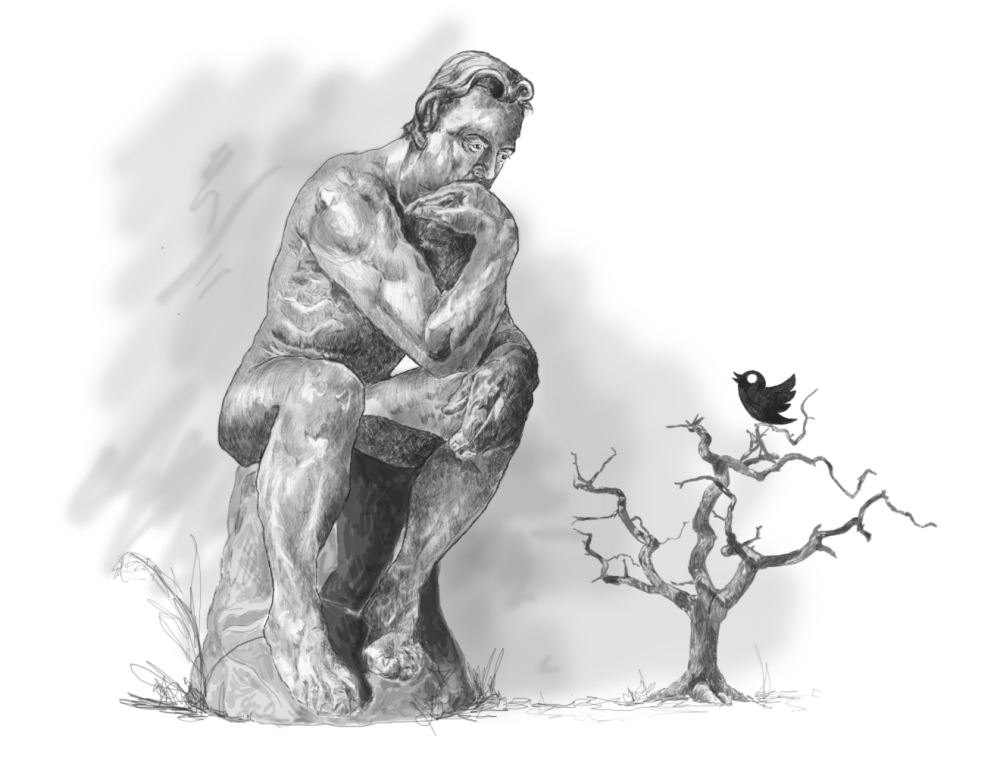
thinkerlarge

By ellymelly – If you enjoy my work, consider shouting me a coffee over on Ko-Fi


It is often the case with human thought that our works of brevity contain caverns of knowledge.

Machiavelli, a Renaissance philosopher, believed that an artist who wished to sketch the mountains should put himself down in the plains. At this distance, the faults and beauty of the towering ranges are easily observed. The same is true of the low-lying fields, whose secrets are indiscernible unless one has the courage to scale the cliffs and look out upon them as an undulating expanse blurring into the horizon. It follows that to comprehend the complexity of a nation’s people, one has to be its leader but only the ordinary citizens are positioned to judge the merits of their ruler.

We see this duality of perspective in our statues. Scattered through parks and cities, they bookmark pages in history when the world shuddered under breath. That is all we are – wind passing over the terrain. We scratch so lightly that it takes a million souls to weather humanity into the features we recognise today.

Mortality drives us to build symbols of permanence. The bronze eyes of Winston Churchill are a shrine for the nameless in his chapter, while an obelisk in a Roman village with a cross protruding like mistletoe from its peak, signifies the conquest of two empires. Their scars both built and maimed the world. Do we judge the beauty of the scaffolding by the same measure as the façade? Our history provides the framework for our moral present. If we tear down its structure, expect the building to collapse.

One after the other our cities fall, humanity recognising no constant except the perpetual desire to destroy itself. Ruins haunt us with the dreams of those we killed. For all their savagery, it does not escape our notice that the most ancient of our kin built works of unparalleled beauty. They climbed from bloodshed, poverty and misery with rock and sweat, creating cities fit for the gods who were imagined as both our torturers and salvation.

The less we have, the more we achieve. When civilisation reaches the point of comfort, those that lounge in the rarefied atmosphere kick in the gates and let hell pour through the streets to begin again. Sometimes, we can’t. Every revolution flips the coin between progress and predatory politics. Fate favours the latter, as it is easier to destroy than build. Gradually, piece by piece, the world is given over to dictators until a cluster of leaders close their eyes and whisper, ‘no’. These outsiders are the men immortalised in bronze.

Few have lived who understood civilisation with Machiavelli’s clarity. He saw our empires as a tally of intertwined personal motivations, dismissing ideology in favour of humanity. History gives him a bad rap because he dared to tell the truth about our behaviour. We do not enjoy looking at ourselves in high definition, particularly stripped away from the platitudes of morality, leaving the secret rules that govern us meticulously detailed. The single finest political work in history, The Prince, is a deceptively short masterpiece in leadership – a cautionary tale for careless rulers and ambitious crowds. Any evil attributed to his name is merely a reflection of what he found in his subject matter.

To those who cling to the Machiavellian verb – to those who invoke his name as a slur synonymous with unscrupulous wickedness – know that his greatest admiration was reserved for Marcus Aurelius, whom he regarded as the best of us. That is what The Prince aspires to; a better world. It is why he rejected false utopias, considering them a dangerous lure. His suspicions were proved correct with every passing century. Those who chased Shangri-La politics brought about the worst depravity in political theory and a pile of skulls that not even Machiavelli could fathom in his nightmares.

The following are Machiavelli’s five suggestions for surviving civilisation.

RISK

“Never let any Government imagine that it can choose perfectly safe courses; rather let it expect to have to take very doubtful ones, because it is found in ordinary affairs that one never seeks to avoid one trouble without running into another; but prudence consists in knowing how to distinguish the character of troubles, and for choice to take the lesser evil.”

This is a warning about the inherit risk civilisation faces simply by existing. It has been the preference of our leaders since the end of the last war to pursue the lowest risk policies at all cost, even when they appear ludicrous. The immediate memory of conflict has given way to the philosophy of pacifism. We have entered the era where our political leaders fear giving minor offence on the world stage rather than engaging in the necessary international geopolitics to preserve the safety and interests of their countries.

The United Nations has used empty threats to coerce obliging leaders in the West out of their money and into treaties that do not benefit them, while power hungry dictatorships climb. Our desire to avoid global conflict and shroud egos with peaceful politics is ironically creating the environment necessary for a third world war. This is what Machiavelli means when he says that safety cannot be guaranteed by saintly behaviour. Civilisations that sit idle are the first to be sacrificed and there is no virtue inviting your cities to be sacked. Allowing others to be invaded without comment for fear of the aggressor makes that aggressor more powerful by the silence. China knows this. By continuously pushing out the boundaries of acceptable behaviour they make anything acceptable, including conquest.

Machiavelli spoke of the Romans, who knew that battle was an inevitable feature of being alive. The best any leader can hope to do is pick which battles to engage in to avoid laying the foundation of wars that cannot be won. Some of these are pre-emptive. Western leaders have been raised to subscribe to the dangerous ideology of ‘make the most of the present time’ while the Romans, in Machiavelli’s words, made the most of their prowess and prudence, thus ensuring that the present time was always secure and advantageous instead of facing gradual erosion.

To them, political strife was like a disease that wasted away the body. If you acted while it was difficult to diagnose – it was also easy to cure. Leaders who waited until the ailment became obvious to everyone, found it invariably fatal. Our disease is the infiltration of violent dictators and ideologies into positions of influence on the boards of institutions that were designed specifically to stop them holding power. No one is safe, least of all their people, if the depraved start orchestrating geopolitics.

VALOUR

“Without doubt princes become great when they overcome the difficulties and obstacles by which they are confronted, and therefore fortune, especially when she desires to make a new prince great, who has a greater necessity to earn renown than an hereditary one, causes enemies to arise and form designs against him, in order that he may have the opportunity of overcoming them, and by them to mount higher, as by a ladder which his enemies have raised. For this reason many consider that a wise prince, when he has the opportunity, ought with craft to foster some animosity against himself, so that, having crushed it, his renown may rise higher.”

It may seem unfair, but humans come from a primordial system of war and adventure. We have, buried in our nature, the desire to vanquish challenges even if they are mundane. As individuals, we continuously place ourselves into open conflict. Children play games with each other and relish in their victories. It is not only how we choose to entertain ourselves, it is the foundation of education. The wild teaches lessons with severe punishments and so we are hard-wired to value those individuals who continually solve problems placed before them. They were the early leaders of humanity – our protectors, heroes, and champions.

The famous figures of our history are usually found in periods of darkness where their fame is the product of an adversary they overcame, often unwillingly. Winston Churchill is remembered for leading the West against the horror of two political ideologies enslaving and murdering their way across Europe. Others chose nature itself to vanquish, by climbing her mountains or pressing into the uncharted edges of the world. They conquered two things; death and the unknown. Even if they failed, their ambition left a revered stain in our minds.

For political leaders, it is rarely enough to beat a rival party at an election (unless that party is of significant threat to the public interest). Do not get me wrong, a political victory carries with it a measure of short term fame, but to achieve one of those bookmarks in the story of humanity, a leader has to be put against a force that the nation will admire him for overcoming. Wars are the natural enemy of a leader and peacetime leaders often find their names fading. Steady economies, serenity, and incomprehensible nests of policy are hardly things to inspire the hearts of citizens.

In order to maintain popularity and power, Machiavelli’s suggestion is to create a circumstance to overcome. To manufacture conflict where there is none. This does not mean throwing darts at a world map and sending in the troops (unless you’re an unscrupulous warlord like Xi Jinping). What he means is to create conflict out of an existing issue. If a leader is fighting poverty in his city, the advice is to talk this up into a war. Pit yourself against the task so that the monotonous completion becomes an event to remember. Or, actively pick political rivals from the ranks of the opposition. Challenge them, even if they’re not much of a challenge…

US President Obama is remembered predominantly for the colour of his skin. In a time of identity politics’ toxic insistence on defining individual value by a mixture of race, sexuality, and gender – his victory was the position of power he reached. It is not enough to stick. The foe of ‘institutionalised racism’ in the US is mostly imaginary in the twenty-first century and after the achievement of election was realised, Obama’s policies were uninspiring.

Love or hate US President Trump, his victory against the Deep State held a similar amount of theatre as Obama’s election – but it is not what he is going to be remembered for. His foes are global super powers Russia, China, North Korea and the entire swamp of the United Nations. He turned unemployment and border security into wars of ideology before being hit by the twin existential threats of a pandemic and rising domestic Communism. This is the sort of noise that enshrines leaders in memory, whether they win or lose.

Why is it not enough to rule well? People are fickle. They grow bored of prosperity and so, for a good government to maintain power, it must adopt a measure of theatre even if its politics are not naturally inclined to drama.

Conservative parities have failed in this task over the last forty years. While they ruled peacefully, the left have been picking battles, creating conflict out of nothing, and rising up with the ghosts of Stalin.

SMALL GOVERNMENT

“It makes him hated above all things, as I have said, to be rapacious, and to be a violator of the property and women of his subjects, from both of which he must abstain. And when neither their property nor their honour is touched, the majority of men live content, and he has only to contend with the ambition of a few, whom he can curb with ease in many ways.”

Machiavelli pre-dated Communism and its little on-ramp to hell (Socialism) by centuries, but he correctly identified the flaw that would lie at the heart of their failure.

Citizens want their leaders to leave them alone.

It might sound simple, but this unifying truth of civilisation has been abused by various forms of government for thousands of years. Dictators raped, pillaged, and burned the property of their people, feudal systems overtaxed the poor causing bloody revolutions, while theocracies erected oppressive social rules to control the minute details of everybody’s lives. Even in the Western democracies of today, we are stuck in an endless battle to keep the creep of government out of our lives where committees of moral busybodies and pick-pocketing bureaucrats treat the people like a buffet. The European Union is another species of this sin, except it plays the game on the grander stage of sovereignty.

No political movement on Earth has indulged the error more than Communism. Karl Marx wrote these ills into the spine of his ideology, attempting to spin state sanctioned theft of private property, indentured slavery, and government ownership of personal thought into a political system advertised as ‘kindness’.

No matter how many apologists attempt to soften the propaganda, humans recognise tyranny when they see it. We are hard-wired to reject the principles of re-distribution from our earliest consciousness where we began creating and collecting trinkets to separate us from the our fellow animals. Humans keep what they work for. They might make a few small tax concessions in return for a leader who protects them from external enemies, or engage in charity work if they can, but the proposition of Communism is no different to Machiavelli’s envisioned despot, riding through villages with a pack of villains.

Conservative politicians should take note that the popularity of your politics lies in the rejection of this ideology. The more autonomy you enshrine into policy, the higher your vote. While you may not be faced with dismantling Communism, it is worth stripping your government of unnecessary incursion into the private life of your citizens, ignore the demands of censorship, and lower taxes wherever possible. This behaviour will take you closer to having a relationship with the citizenry based on respect rather than force.

DEFENCE

“We have seen above how necessary it is for a prince to have his foundations well laid, otherwise it follows of necessity he will go to ruin. The chief foundations of all states, new as well as old or composite, are good laws and good arms; and as there cannot be good laws where the state is not well armed, it follows that where they are well armed they have good laws.”

Or put more familiarly, ‘law and order’. The two pieces of civilisation have been latched together since antiquity because law, by its very nature, is enforced. Peaceful nations require solid laws to keep criminality at bay or else risk falling into the common state of anarchy found in the world’s failed entities.

With serious political leaders in the West embracing the idea of abolishing their police forces, there could not be a more poignant moment to remember Machiavelli’s warning. Ordinarily, countries are not stupid enough to dismantle their own police systems. Usually it happens during an external siege where a larger war robs a city of their police and the defenceless citizens are left to the mercy of warlords and criminals. Dismantled law gives way to the lowest form of social control by the mob until liberty exists only for those with sufficient brutality.

The same can be said about the gradual reformation of law. To achieve what Machiavelli puts as, ‘good laws’ requires a process of enforcement that can judge a law’s merit as it is written. For example, ridiculous laws prove impossible to police and are dropped entirely. Laws that are out of step with majority behaviour share the same fate. If a leader, in a fit of ego, decides to introduce a law banning an activity that everyone engages in and loves, he risks a rebellion for trying to fill his jail cells. Jonathan Sumption, in his lectures about Law’s Expanding Empire, carries this argument through to its natural conclusion where unenforceable laws risk the validity of the government or body writing them until finally, their authority is no longer recognised. It is the act of policing that conducts a Litmus test on the health of legal systems.

To enforce a good law requires the arming of police. If police are not respected and yes, feared, then criminals cannot be policed. We have seen in recent weeks our police running from violent mobs – unable to stand their ground and protect public and private property from gangs of opportunistic vandals. This leads immediately to the destruction of society.

This is not an argument from Machiavelli about creating a military force to police citizens. The point of democratic politics is to sit above the police force as a system owned by the people. It is them, the people, who write the laws and decide upon how they wished to be governed. Once decided, the laws have to apply equally to all or else jealousy erupts inside the populous.

A situation we are seeing play out today.

We have bad laws, weak police, and inconsistent politicians.

ADVICE

“And if there are some who think that a prince who conveys an impression of his wisdom is not so through his own ability, but through the good advisers that he has around him, beyond doubt they are deceived, because this is an axiom which never fails: that a prince who is not wise himself will never take good advice, unless by chance he has yielded his affairs entirely to one person who happens to be a very prudent man. In this case indeed he may be well governed, but it would not be for long, because such a governor would in a short time take away his state from him.”

All leaders take advice, even those who do not surround themselves with visible advisors. There is a fine line between listening to a range of opinion and being presented to the world as a plaything of conspirators.

A leader must be prepared to take his own opinion – to trust it and to pursue it if he thinks it is better than the crowd of advice offered at his ear. The people elect leaders for this express purpose – to lead on the promises they made at election. There are often points in history where the systems surrounding a leader have formed institutions against the desires of general population. In this case, their advice is bad advice, even if it is the prevailing noise. The Deep State is a notable example of an entire political class that has fallen out of step. We see it perhaps more insidiously with the prevalence of identity politics where a minority of opinion in the population has become over represented in the upper echelons of politics. This has resulted in the majority voting for combative leaders whose job it is to walk against the torrents of unsolicited advice.

Scott Morrison is a Conservative Prime Minister in Australia governing during a time of plummeting support for the United Nations, the Renewables industry, and government censorship – yet all three things have been endorsed and expanded on the advice of those that surround him. This not only makes him personally unpopular, his voters either see him as a traitor to the cause he was elected to serve or a weak-willed leader bent over the knee by the Canberra press gallery.

Fearing the press is the most dangerous thing the political class ever decided to do. The press have their own interests sitting somewhere between clickbait and personal politics. The only thing a politician should fear is the opinion of the people who elected him.

Yes, Machiavelli acknowledges that it is possible to be advised well and that some leaders may be lucky, but the best leaders are certain of their own minds and are not afraid to offer their honest opinions when confronted by questions.

In conclusion, Machiavelli says that, ‘goodwill and fortune are the two most inconstant and unstable things. Nevertheless, he who has relied least on fortune is established the strongest.’

His lesson is the same as the one offered by our grandparents. Rely on yourself, work hard and you will achieve great things. Only the fool assigns his fortune to life’s sadistic gamble.


By ellymelly – If you enjoy my work, consider shouting me a coffee over on Ko-Fi. I have to purchase a new laptop this month, so it’s even more appreciated than normal. ❤